

OPC vs PPC Cement: Key Differences, Uses, and Which One to Choose
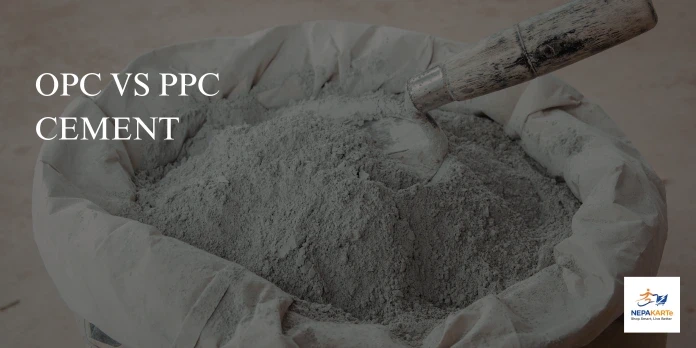
The type of cement to use in any construction project is one of the most critical decisions made in any construction project since it directly influences the strength, durability, cost, and long-term performance. Of all the cement varieties that are in the market, the OPC vs PPC debate is one of the most widespread amongst builders, engineers, and homeowners.
When choosing between OPC vs PPC, many individuals are usually confused, as they are assumed to be the same thing. But the thing is that both types possess their own peculiarities, benefits, and best practices. When you make a wrong decision, it is likely to affect the structural quality of your building in the long run.
We shall simplify and make OPC vs PPC very practical in this guide in a manner that the non-technical will clearly understand. You will know their differences, uses, strengths, and which is the best to use in your construction requirements in Nepal and other places.
What is OPC Cement?
To have a clear understanding of OPC vs PPC, we first must comprehend what OPC cement is all about. OPC is the abbreviation of Ordinary Portland Cement, a common type of cement used in the construction industry. It is characterized by being very strong and setting rapidly.
Comparing OPC vs PPC, OPC is regarded as traditional to use in projects when the speed of strength development is needed. It comes about through grinding of clinker and gypsum and is thus strong and, in long-term exposure, a bit weaker than PPC.
It's imperative to understand OPC since most of the variations in OPC vs PPC are directly related to its properties and behavior when in construction.
OPC Cement Composition (Detailed Explanation)
OPC cement is primarily composed of clinker and gypsum that are subjected to high temperatures and finely ground. The strength of cement is provided by clinker, and gypsum controls the setting time to ensure that cement does not harden too fast.
This simpler composition in OPC vs PPC makes OPC a fast-setting compound. Nonetheless, due to the absence of additional products, such as fly ash, it produces a greater amount of heat in the hydration process. This heat can be advantageous in smaller buildings, but can prove to be a drawback in large-scale buildings when thermal cracking is an issue
This also translates to the fact that OPC reacts more directly with water, thus hardening faster, but with slightly less resistance to environmental stress over time than PPC.
Key Properties of OPC Cement (Detailed Explanation)
Comparing OPC and PPC, the former is more advantageous because of its early strength development and rapid setting. This would be suitable in projects where time is a sensitive variable. Once water is added, the cement starts to react rapidly, which enables the construction to proceed faster than PPC.
But this quick response also causes increased heat, which may occasionally result in the formation of micro-cracks in large concrete structures unless well managed. This is the reason why OPC is more likely to be applied in smaller or time-conscious projects, but not in huge continuous pours.
The other property that is significant is that it is suitable for high-load structures at its early stages. Although in the long run, PPC has more strength, OPC offers instant structural support, which is essential during initial construction stages.
What is PPC Cement?
Portland Pozzolana Cement is a blended cement, which contains pozzolanic substances like fly ash or volcanic ash in addition to the conventional OPC clinker. This mixture has a huge effect on the behavior of the cement with time.
PPC has been associated with performance in the long term as opposed to early strength in OPC vs PPC. It acquires power gradually and is more persistent and fixed with time. This renders it particularly appropriate in residential buildings, foundations, and buildings that are prone to moisture or chemical environments.
PPC is also said to be more eco-friendly since it makes use of industrial by-products, thus minimizing the general carbon emissions in the production of cement.
Definition of PPC Cement (In-depth Explanation)
PPC cement is a mixed cement that is aimed at enhancing the duration and structural stability. In contrast to OPC, which is more concerned with early strength, PPC is more concerned with the development of strength, which is gradual and lasts a longer time.
PPC is more of a long-term stabilizer in OPC vs PPC. It is especially applicable in places where buildings need to be resistant to changes in weather, exposure to moisture, or even chemical assaults. It has a slow hydration process, which enables it to develop a denser and more compact structure with time.
This renders PPC very appropriate for residential structures where durability and safety are more significant than the rapid development of the structure.
Composition of PPC Cement (Detailed Explanation)
PPC composition consists of OPC clinker, gypsum, and pozzolana, such as fly ash. These extra materials combine with calcium hydroxide emitted during hydration to create additional cementitious compounds.
It is this chemical reaction that makes PPC stronger in the long term when compared to OPC. Fly ash not only enhances durability but also decreases permeability, thus making the structure more waterproof and immune to chemical destruction.
Due to this mixed structure, PPC requires more time to settle than OPC but ultimately forms a better internal structure that is more effective when it is subjected to long-term exposure.
Key Properties of PPC Cement (Detailed Explanation)
The low heat of hydration is one of the most significant properties of PPC in comparison with OPC and PPC. This makes it safer to construct in large masses of concrete, as there is a risk of cracks.
PPC also exhibits better working qualities, i.e., it is easier to mix, place, and finish in construction. This is particularly popular among masons and contractors engaged in work on residential projects.
The other important property is the increased resistance to chemicals and environmental conditions. With time, PPC gets denser and thus more durable than OPC in most practical applications.
OPC vs PPC Cement: Major Differences.
Comparing OPC vs PPC, the distinctions are not only technical but also practical in terms of usage, cost, and performance in the long term. OPC offers quicker results, whereas PPC is concerned with durability and sustainability.
In actual construction projects, the decision between OPC vs PPC is largely influenced by project requirements like schedule, exposure to the environment, and cost. Each type performs a particular role, and proper use guarantees enhanced structural performance.
The major difference is in the behavior of both materials with time. OPC is fast and obtains an initial momentum, whereas PPC is slower but eventually acquires a more robust and solid structure.
Strength and Performance Difference
In OPC vs PPC, OPC gains strength rapidly over a short duration, and therefore is suitable for projects that need to have early load-carrying capacity. PPC, on the other hand, develops strength slowly, yet over time, it becomes stronger than OPC in terms of long-term durability.
This renders OPC to be used in fast-track projects, whereas PPC is used in long-lasting residential and commercial buildings.
Heat of Hydration Difference
The hydration process in OPC produces more heat and may cause cracks in large buildings unless controlled. PPC produces significantly less heat and is therefore safer to use in mass concrete in OPC vs PPC.
This is particularly significant in hot climates or in large foundations where there is a concern of thermal stress.
Durability and Lifespan Difference
In the case of OPC vs PPC, the latter is obviously more durable as it is dense and resistant to chemicals. OPC is effective at low concentrations, but it might not be as effective in the long-term when exposed to moisture or other adverse conditions.
PPC is thus used in buildings that need to have long service and have minimal maintenance.
Cost and Practical Usage
PPC is more affordable in OPC vs PPC and is a common option in residential construction. Although OPC is a little more expensive in most applications, it is warranted in the project where speed and early strength are needed.
OPC vs PPC Cement in Real Construction Scenarios
This part fills the gap between theory and practice, which is usually lacking in the majority of technical cement articles. Although definitions and differences are essential, the majority of builders and homeowners do not make their decisions using the theoretical knowledge of construction, but in real construction scenarios. This is why it becomes incredibly important to comprehend the performance of OPC vs PPC in real-life settings.
In real-life construction practice, OPC vs PPC is not only a technical affair but a viable choice based on weather conditions, type of building, budget, and even the speed of construction. As an example, OPC can be preferred in fast-moving commercial projects because of its rapid strength gain, but PPC can be used in residential housing projects because of its durability and long-term stability.
In areas such as Nepal, where climatic changes and exposure to moisture are the norm, OPC vs PPC choices become more critical. The builders are faced with a dilemma of speed of construction versus long-term structural protection. The section will make you realize the way each cement performs in various real-life conditions.
Residential Building Applications
In residential buildings, OPC vs PPC is commonly considered in terms of the safety and cost-effectiveness in the long run. The majority of house owners are more concerned with resistance rather than speed since a house is not a short-term project, but a long-term investment. This is the reason why PPC is popularly used in the foundations of houses, slabs, plastering, and general masonry construction.
OPC is, however, occasionally employed in certain locations where it is necessary to have early strength, like columns or structural beams, in early stages of construction. This combination technique is also common in OPC vs PPC, whereby the experienced contractors balance strength and durability.
The most important lesson, herein, is that residential construction is not based on one type of cement but tends to incorporate both types of cement based on the needs of the structure and construction phases.
Commercial and Infrastructure Projects
In industrial and infrastructural projects, OPC vs PPC is a choice depending on engineering needs, not necessarily on price. OPC is widely applied in works such as highways, bridges, and industrial buildings, where the strength in the early stages and the rapid construction time are significant.
PPC, on the other hand, is frequently applied in large concrete buildings where thermal resistance and durability are paramount. In OPC vs PPC, infrastructure engineers will tend to use PPC due to its ability to resist chemical exposures and lower the chances of crack propagation during large pours.
This renders PPC more appropriate in the long-term public infrastructure, whereas OPC promotes construction projects that are speed-based.
Environmental Impact and Sustainability of OPC vs PPC Cement
Sustainability has come to play a role in construction in modern times, and this is where the OPC vs PPC has a significant disparity. One of the largest contributors of carbon emissions in the world is cement production, and thus, the selection of a more environmentally responsible one is becoming a more important concern to builders and governments.
In the case of OPC vs PPC, PPC is the more environmentally friendly alternative as it incorporates industrial by-products such as fly ash. This not only minimises the waste but also minimises the quantity of clinker needed in production, which in turn minimises carbon emissions.
Although OPC is very efficient in construction performance, it has an increased environmental footprint owing to high consumption of energy in the production of clinker. This not only renders OPC vs PPC a technical or financial choice but also an environmental one.
Carbon Footprint Comparison
In OPC vs PPC, the difference in carbon footprint is primarily because of the production process. OPC involves more energy-consuming processes, and thus it emits more CO 2. PPC minimizes this effect by substituting some of the clinker with fly ash, which is also a by-product of industry.
This renders PPC a more viable solution to construction projects that are environmentally friendly. Typically, the current infrastructure development trend favors the use of PPC over other materials due to its minimal environmental impact with regard to structural integrity.
Long-Term Sustainability Benefits
In examining OPC vs PPC, PPC has more than environmental savings as a long-term sustainability benefit. PPC structures are less susceptible to environmental damage and therefore take shorter durations to maintain and repair, due to their durability.
This indirectly saves consumption of resources and waste of construction in the long run. PPC is nowadays regarded as the material of choice in green building construction, as far as sustainable construction is concerned.
Conclusion
Overall, it is not a matter of OPC vs PPC, but the issue of which of these two types of cement would best fit into your construction requirements. OPC is suitable for high-strength and fast applications, whereas PPC is suitable in terms of durability, low cost, and performance.
Learning about OPC vs PPC, builders and homeowners will be able to make wiser choices, which will enhance the quality of the structures and their safety in the long run.
Recent Posts






Roof Insulation: Powerful Benefits for a More Comfortable Home



NEPAKARTe is a modern eCommerce platform dedicated to making online shopping simple, reliable, and accessible for everyone. We bring together a wide range of quality products from trusted Sellers & trusted Brands offering customers a convenient way to discover, compare, and purchase what they need all in one place.
Follow Us
Contacts
-
Address
Kuleshwor, Kathmandu.
-
Phone
+977-97052-46000
-
Email
My Account
Payment Partners

-
Address
Kuleshwor, Kathmandu.
-
Phone
+977-97052-46000
-
Email