

Difference Between Tools, Equipment, and Machines: Complete Guide with Practical Examples
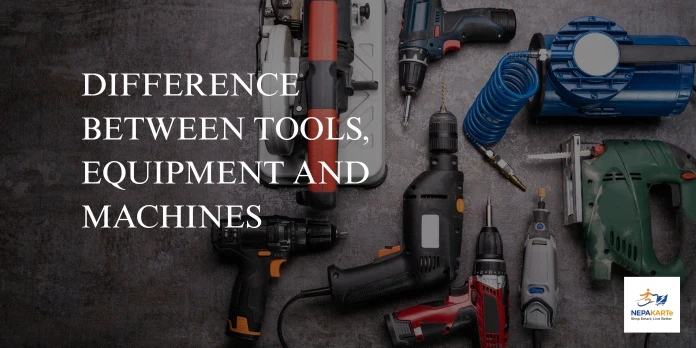
Different tools, equipment, and machines serve different purposes and offer distinct advantages. There are different types of tools, equipment, and machines that are used for different purposes and have different benefits.
The difference between tools, equipment, and machines is related to their design, operation, and use to carry out work. A tool is usually a hand-held device that an individual uses directly; equipment is a group of tools or devices that are used to carry out a particular task; and a machine is an automatic or semi-automatic device that carries out work.
Homeowners, contractors, engineers, technicians, workshop owners, and businesses need to comprehend the distinction between 'Tools, Equipment and Machines' to ensure they select the most appropriate option, enhancing productivity, safety, and cost-effectiveness. While these words are often used synonymously, they can mean different things in different sectors like building, production, farming, automobile maintenance, and home improvement.
What is the Difference Between Tools, Equipment, and Machines?
|
Feature |
Tools |
Equipment |
Machines |
|
Definition |
Handheld devices used directly by a person |
Items that assist or support specific work |
Powered systems that perform work automatically or mechanically |
|
Human Effort |
High |
Moderate |
Low |
|
Power Source |
Mostly manual |
Manual or powered |
Electrical, hydraulic, pneumatic, fuel, or mechanical |
|
Complexity |
Low |
Medium |
High |
|
Cost |
Usually lower |
Moderate |
Generally higher |
|
Portability |
Highly portable |
Depends on size |
Often fixed or heavy-duty |
|
Common Users |
DIY users, technicians, carpenters |
Professionals, contractors, workshops |
Factories, construction sites, industries |
|
Examples |
Hammer, wrench, screwdriver |
Air compressor, welding set, scaffolding |
Lathe machine, excavator, milling machine |
Below is the Difference Between Tools, Equipment, and Machines table that will help to understand the contribution of each to various types of work.
What are Tools?
Tools are hand-held or portable devices that are used to help achieve a specific task with precision and control.
Tools are the basis of almost any repair, construction, maintenance, and manufacturing job. They augment human ability: They make work faster, safer, and more accurate. Tools are necessary in a multitude of industries, whether they're being used to tighten a bolt, measure a surface or cut wood. The hand tools market is still on the rise, with construction and DIY projects rising around the globe, according to Statista.
What is the definition of a tool?
A tool is any device that allows a person to carry out a task through direct manual control.
Tools are dependent, largely, on the physical work and skill of the person using them, as opposed to machines. Others rely on manual labor, while other tools, like cordless drills and angle grinders, rely on electricity or batteries to make them more efficient. The operator is always completely in control, irrespective of the power source.
Specialised tools are essential for precision and safety in professional trades like carpentry, plumbing, electrical work, masonry and auto repair. One of the most popular sayings in the field of management consultancy is that of Peter Drucker, who claimed that "Efficiency is doing the right thing; effectiveness is doing the right thing right.
What are the main characteristics of tools?
Tools are built to be accurate, portable, and easy to use.
There are some common features of most tools that make them useful for the work of a day-to-day basis:
-
They are created to work on a single specific job or tasks and in an efficient way.
-
They tend to be light and portable from place to place.
-
Most tools need to be operated by humans.
-
They can be operated manually as well as by power.
-
Quality tools are constructed from high-quality materials, such as hardened steel, alloy steel, or high-quality composites.
All these features make tools useful for use in an array of projects, both at home and at work.
What are the different types of tools?
Tools are used in many industries, and their classification is based upon the work they do.
Knowing the types of products and what they are used for enables the user to select the appropriate one for the application.
Hand Tools
Hand tools work only with the help of man.
These include hammers, screwdrivers, pliers, chisels, spanners, wrenches, utility knives and hacksaws, etc. They are very popular due to their maintenance-free and costless operation without an external power supply.
Power Tools
Power tools are mechanical devices that use electricity, batteries, or compressed air to help them work faster.
Devices such as cordless drills, rotary hammers, angle grinders, impact wrenches, circular saws and jigsaws are common examples. In the long-term, the global power tools market is expected to see a notable surge in growth as a result of infrastructure development and industrial automation, according to a report from Grand View Research.
Measuring Tools
Work starts with improved accuracy using measuring tools.
Tape measures, laser distance meters, spirit levels, vernier calipers, and measuring wheels are examples. Accurate measurements decrease the waste of resources and increase the quality of the project.
Cutting Tools
Cutting tools are used to efficiently remove or shape material.
They are used for utility knives, bolt cutters, pruning shears, pipe cutters, and woodworkers and metalworkers saws.
Fastening Tools
Fastening tools help to hold parts together in a safe and precise manner.
These include screwdrivers, socket sets, torque wrenches, rivet guns, nail and staple guns, and are used in the construction and manufacturing industry.
What are some common examples of tools?
Tools are used in most households, workplaces and factories.
These are some of the more popular tools:
-
A claw hammer with which to drive and pull nails.
-
A set of screwdrivers used for putting things together and fixing electronics.
-
A combination wrench to use for nuts and bolts.
-
A tape measure to work out accurate measurements.
-
A tool with a movable bar to help with plumbing and mechanics.
-
A wireless drill bit for making holes and attaching screws.
-
Wire Cutting, Bending and Gripping Pliers.
These tools are considered essential as they can be used across multiple industries in various maintenance, repair, and installation tasks.
What is Equipment?
Equipment is devices, systems, or sets of tools used to enable individuals to do specific jobs in a more efficient and safe manner.
Equipment may have several parts required for larger or more complex operations than individual tools. Equipment is used for enhanced productivity, enhanced safety, and to decrease manual labour in construction projects, manufacturing plants, workshops, farms, and laboratories. Investing in new industrial equipment can bring a huge boost in productivity, with better operational efficiency.
What are the main characteristics of equipment?
Tools are designed to enhance efficiency, safety, and uniformity in work activities of professionals and industry.
Although equipment differs from industry to industry, there are some similarities between most of the types of equipment and ordinary tools.
-
Equipment can consist of several parts that are combined to carry out a function.
-
It can be operated manually, electrically, hydraulically, pneumatically or fuel-powered.
-
Equipment tends to be more powerful, heavier, and specialized than hand tools.
-
It needs to be inspected, serviced, and maintained regularly to ensure that it is performing properly.
-
Industries are vital to their profession and require equipment to become more efficient, accurate, and safe in the workplace.
Such traits make equipment suitable for use in the construction industry, manufacturing, agriculture, logistics, auto repair shops, and commercial maintenance.
What are the different types of equipment?
The equipment is classified based on its industry and application.
Each category is developed to address different operational issues and enhance productivity and decrease manual effort.
Construction Equipment
Construction equipment is used in construction, demolition, excavation, and infrastructure construction.
Concrete mixers, scaffolding systems, compactors, plate vibrators, water pumps, and generators are examples of machinery where heavier models would be best suited for higher lifts. In concrete mixers, scaffolding systems, compactors, plate vibrators, water pumps, and generators, the heavier models should be used for higher lifts. They contribute to the construction industry's ability to do more with less and deliver quality projects on time with the same safety standards.
Industrial Equipment
Industrial equipment is the type that has to be run continuously in manufacturing/production lines.
Examples of common air compressors in factories and workshops include air compressors, welding systems, conveyor systems, hydraulic presses, and material handling units.
Safety Equipment
Safety equipment is a medical tool that helps to prevent injuries and occupational hazards to workers.
These products include safety helmets, protective eyewear, gloves, ear protection, respirators, safety harnesses, and reflective clothing. The International Labour Organization (ILO) reports over 2.9 million deaths from work-related accidents annually, and the right safety equipment is essential for lowering the risk on the job.
Agricultural Equipment
Farm machines increase the productivity of agricultural activities and also minimize human tasks.
This can be anything like irrigation pumps, sprayers, seed spreaders, brush cutters, grass cutters, and harvesting equipment for farmers to boost productivity.
Material Handling Equipment
Material handling equipment is used for the safe and efficient movement, lifting, and storing of heavy materials.
Forklifts, pallet trucks, lifting chains, trolleys, and hoists help to minimize manual lifting and maximize warehouse efficiency and safety.
What are some common examples of equipment?
Everyone has come across equipment in their profession, as it assists in bigger and more challenging jobs than individual tools.
Examples include:
-
Equipment for welding metal for fabrication and joining.
-
To power pneumatic tools, air compressors are used.
-
Construction site Concrete Mixers.
-
Irrigation and drainage water pumps.
-
Scaffolding Systems for Safe work at heights.
-
Back-up electrical power portable generators.
-
Industrial and commercial pressure washers.
The examples illustrate how equipment can provide a link between basic hand tools and complete automated machines.
What are the key differences between tools, equipment, and machines?
The main difference between tools, equipment, and machines is based on their use, complexity, level of automation, and need for human effort.
These three terms are very closely related, but are for different levels of work. Tools enable people to do things manually; equipment helps to support and enhance operations, but machines are used to perform repetitive and/or heavy-duty tasks that require mechanical or electrical power. The modernisation of machinery and advanced equipment can increase productivity by 15-30% for enterprises, depending on the specifics of the business and processes.
How do tools, equipment, and machines differ in purpose?
A tool will be used to do one thing, equipment will be used to help with a number of tasks, and a machine will be used for a production process or for heavy-duty tasks.
For instance, a carpenter can use a hammer to drive nails, a contractor can utilize scaffolding equipment to help him/her safely do construction work, or a factory can use an automatic cutting machine to produce hundreds of products daily. They both have different functions and roles to perform, but the overall project is the same.
How do tools, equipment, and machines differ in size and complexity?
The size and complexity of tools, equipment, and machines all increase as you progress from Tools to Equipment and then to Machines.
A screwdriver is easy to store and carry around; an air compressor needs space to store and requires maintenance. An excavator, however, has a lot of intricate hydraulic systems, electronic controls, and an engine that can discharge a number of tons of material at a single time.
How do tools, equipment, and machines differ in power sources?
Usually, tools need human power; equipment can be manual or powered; and there are very few machines that don't need an external power source.
Nowadays, machines are run with electricity, diesel, hydraulics or pneumatics. When choosing tools, equipment, and machine products for construction or industrial purposes, this distinction is one of the easiest to comprehend: the Difference Between Tools, Equipment, and Machines.
How do tools, equipment, and machines differ in cost and maintenance?
The cost of investment and maintenance is usually the highest for machines, and the lowest for tools, with equipment in between.
Hand tools may need to be cleaned and occasionally prevented from rusting, while equipment needs regular checks or maintenance. Mechanical components must be replaced, and software diagnostics and preventive maintenance programs are needed to keep industrial machines running.
How do tools, equipment, and machines differ in skill requirements?
The more sophisticated and complicated the item, the more training that needs to be provided for safe operation.
Basic hand tools can be employed after little instruction; equipment may need professional training. In many cases, machinery like excavators, CNC machines, and forklifts is heavy-duty and needs certified operators, as these machines can cause severe accidents and losses if they are not used properly.
How do tools, equipment, and machines differ in portability?
Tools are generally movable; equipment is movable but not necessarily; and machines are often stationary or need transportation equipment.
This difference has a direct impact on the use of the products and where. Portable tools are perfect for repairs and maintenance, or large machines are perfect for factories, warehouses, and big construction sites.
How are tools, equipment, and machines used in different industries?
When you look at the Difference Between Tools, Equipment, and Machines in the real world in various industries, it becomes much clearer.
All industries require a mix of these three categories to accomplish the job in an efficient manner. The relationship is the same: tools do things, equipment helps things happen, and machines make things happen faster. World Bank estimates show that investment in industrial technology and mechanization keeps enhancing productivity in developing economies, especially in manufacturing and infrastructure.
Construction Industry
Hand Tools are used by construction professionals when precise work is required, for example, trowels, spirit levels, and measuring tapes. Daily activities are supported by equipment like concrete mixers, scaffolding and compactors, while heavy earthmoving and excavation are handled by machines such as excavators, loaders, and bulldozers.
Automotive Industry
Mechanics use torque wrenches, socket sets and screwdrivers to make repairs. Vehicle lifts, air compressors, and wheel-balancing systems are examples of equipment, while computerized wheel alignment machines and engine diagnostic systems are examples of automated push-button service.
Electrical Industry
Electricians use insulated screwdrivers, wire strippers, pliers and voltage testers daily. Cable pullers and testing machines increase installation efficiency, and industrial cable processing machines process electrical manufacturing in large quantities.
Agriculture
Pruning shears, sickles, and hand forks are common tools used by farmers. Irrigation, sprayers, and fertilizer spreaders are used as equipment, and tractors, harvesters, and combine machines are used for large-scale farming with minimal human intervention.
Home Improvement and DIY Projects
It's pretty often that the homeowner will only need a few simple hand tools for repairs such as hammers, adjustable spanners, measuring tapes, etc. For larger renovations, ladders, pressure washers, or portable generators may be required, and for some construction jobs, tile cutters or concrete cutters are essential.
Recent Posts






Roof Insulation: Powerful Benefits for a More Comfortable Home


NEPAKARTe is a modern eCommerce platform dedicated to making online shopping simple, reliable, and accessible for everyone. We bring together a wide range of quality products from trusted Sellers & trusted Brands offering customers a convenient way to discover, compare, and purchase what they need all in one place.
Follow Us
Contacts
-
Address
Kuleshwor, Kathmandu.
-
Phone
+977-97052-46000
-
Email
My Account
Payment Partners

-
Address
Kuleshwor, Kathmandu.
-
Phone
+977-97052-46000
-
Email